
It's the Match That Matters: Reinforcing Honest Self-Monitoring with Self & Match
Oct 13, 2026

Liz Maher
May 11, 2026
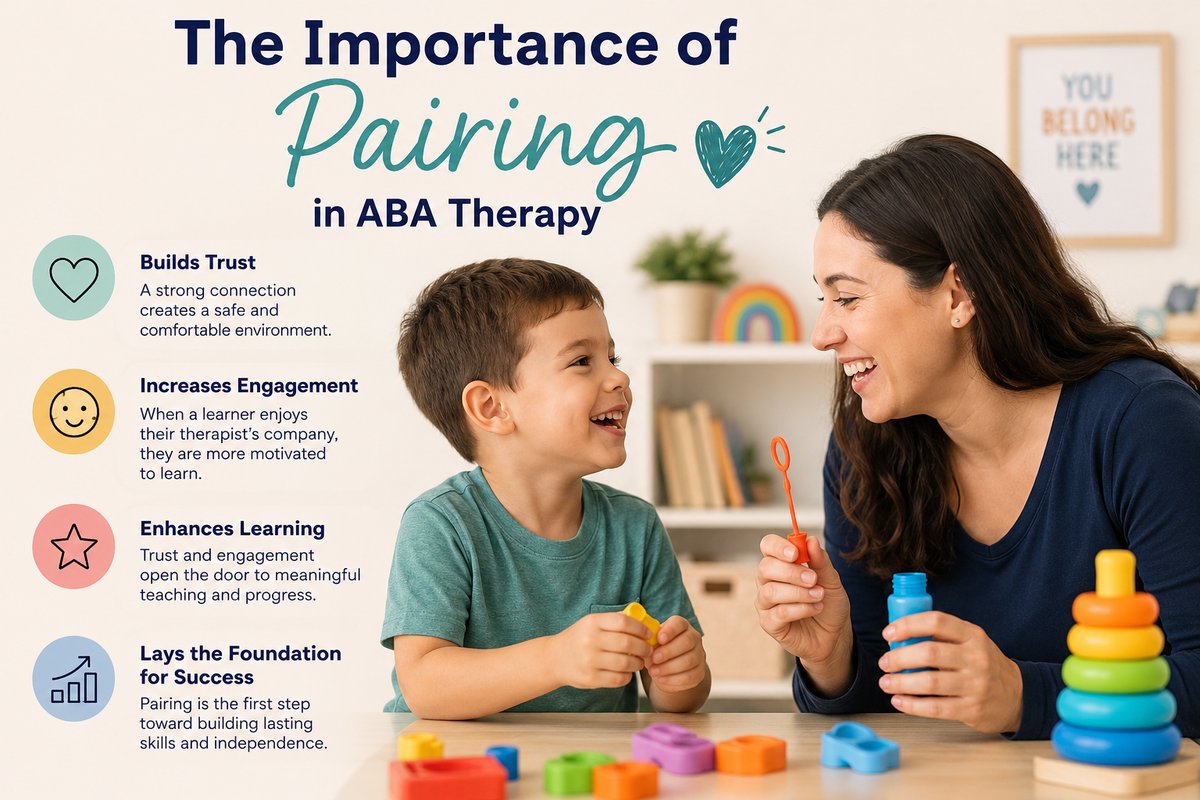
Let me ask you something: have you ever walked into a session with a new client and immediately started placing demands? Maybe you pulled out flashcards, asked them to sit down, or jumped into a structured program because the treatment plan was ready and the clock was ticking. If you have, you're not alone. There's a lot of pressure in our field to show progress quickly, to justify hours, and to demonstrate that services are "working." But here's what I've seen over and over again: when we skip pairing or rush through it, everything else gets harder. Cooperation and instructional motivation drops. Problem behavior increases. Skill acquisition slows to a crawl. And sometimes, we end up spending more time managing escape and avoidance than we ever would have spent just building a solid relationship from the start.
Pairing isn't a warm-up. It's not something you do for the first five minutes of a session and then move on. It's the ongoing process of associating yourself with reinforcement so that the learner actually wants to engage with you. And when it's done well, it changes everything.
At its core, pairing is a conditioning procedure. You're taking yourself, a neutral (or sometimes aversive) stimulus, and repeatedly associating yourself with things the learner already finds reinforcing. Over time, you become a conditioned reinforcer. Your presence signals good things. Your voice, your face, your proximity all become cues that predict access to preferred items, activities, and interactions.
This isn't just a "nice" thing to do. It's a behavioral process with real implications for how effective your teaching will be. When a therapist is well-paired, cooperation and working together comes more naturally. The learner is more likely to attend, respond, and tolerate the mild difficulties that can come with learning something new. When a therapist is poorly paired, or not paired at all, every demand feels like a bigger ask. And the learner's behavior will tell you that loud and clear.
Here's what pairing is not: it's not bribery. It's not letting the child "do whatever they want" indefinitely. It's not avoiding all expectations forever. It's a strategic, time-limited investment that pays dividends across every domain you'll eventually target.
If pairing is so important, why does it get shortchanged so often? A few reasons come up again and again:
Pressure to show immediate progress. Supervisors, parents, and funding sources all want to see data moving in the right direction. It can feel hard to justify sessions where "all we did was play." But that play is doing something. It's building the foundation that makes everything else possible. Remember you can also take data on pairing.
Confusion about what pairing looks like. Some therapists think pairing means sitting near the child and handing them things. But true pairing is active. You're inserting yourself into the reinforcement. You're the one spinning them around, blowing the bubbles, making the funny noise, building the tower. The good stuff is coming through you, not just near you.
Pairing gets treated as a one-time event. You pair during the first week, and then you're "done." But pairing needs to be maintained throughout the therapeutic relationship. If you start placing too many demands without enough reinforcement, you can erode the relationship you built. Think of it like a bank account: you need to keep making deposits if you're going to make withdrawals.
Staff turnover. In many ABA settings, therapists rotate or new RBTs are introduced frequently. Each new person needs to go through the pairing process. There are no shortcuts here. The learner doesn't generalize their relationship with one therapist to every new adult who walks in the door.
How do you know if you're well-paired with a learner? Look at the behavior. The data will tell you.
Signs pairing is working:
The learner approaches you or moves toward you voluntarily.
They make eye contact, smile, or vocalize when you arrive.
They accept items or interactions from you without hesitation.
They tolerate brief, low-demand interactions without engaging in escape behavior.
They show signs of shared enjoyment during play.
Signs pairing needs more work:
The learner moves away from you or turns their body away.
They cry, tantrum, or engage in problem behavior when you enter the room.
They take items from you but immediately move away.
They don't reference you during play or preferred activities. This joint attention we are seeing is one of the major "players" in future success
Cooperation with even simple requests is consistently low.
If you're seeing the second set of indicators, resist the urge to push through. Go back to pairing. It's not a step backward. It's the most efficient path forward.
So what does good pairing actually look like in practice? Here are some strategies that work across age groups and settings:
Watch what they gravitate toward. If they're spinning the wheels on a car, get down on the floor and spin wheels too. Don't redirect. Don't add demands. Just be present in their world, doing what they're doing, and making it slightly more fun because you're there.
During dedicated pairing time, the learner doesn't have to "earn" anything. You're giving freely. This is non-contingent reinforcement in action, and it's powerful. Hand them their favorite snack. Start their favorite song. Offer the iPad. No strings attached.
This is the key piece many people miss. Don't just hand the child a toy and walk away. Be the one who activates the toy, who pushes them on the swing, who makes the funny sound effect. You want the child to learn that good things happen because of you, not just in spite of you.
This is hard, especially when you're eager to start teaching. But placing demands before you're well-paired can undo your progress. A good rule of thumb: wait until you see consistent approach behavior before introducing any expectations. And when you do start placing demands, keep them small and easy to reinforce.
If a learner has been out sick for two weeks, or if you had a rough session with a lot of problem behavior, take time to re-pair. Don't assume the relationship is still where you left it. Check in behaviorally and adjust.
One thing I want to emphasize: pairing isn't only relevant at the start of services. It's relevant every single session. The best therapists I've worked with maintain a high ratio of reinforcement to demand throughout their sessions. They keep the energy positive. They read the learner's behavior and pull back when motivation is low. They never stop investing in the relationship. This is especially important during transitions. When a learner moves from one therapist to another, when they transition to a new setting, or when programming gets harder, pairing becomes even more critical. The relationship is what carries you through the difficult stretches.
If you're a BCBA supervising RBTs, build pairing into your training and your expectations. Don't just tell new staff to "play with the kid for a few minutes." Teach them what pairing looks like, what to watch for, and how to assess whether it's working. Give them permission to take the time they need. And model it yourself. If you're a parent, know that those early sessions where it looks like "nothing is happening" are actually laying the groundwork for everything that comes next. A therapist who takes time to build a genuine connection with your child is doing something deeply important, even if it doesn't look like traditional "therapy" yet.
Pairing is not a luxury. It's not wasted time. It's the behavioral mechanism that makes cooperation and instructional motivation possible, that reduces problem behavior, and that creates a therapeutic environment where learning can actually happen. Skip it, and you'll spend months fighting uphill. Invest in it, and you'll wonder why you ever tried to do it any other way. Remember you can not teach someone who is running away from you!
The relationship is the intervention. Everything else builds on top of it.
Written by
Liz Maher
Liz Maher, MEd, BCBA, is an experienced Board Certified Behavior Analyst who provides consulting services to educational institutions and is the parent of a young adult with autism.
Explore our resources and training programs for ABA professionals, educators, and parents.