"What You Hold Up Matters: Selecting Stimuli for the VB-MAPP"
Oct 5, 2026

Liz Maher
April 28, 2026
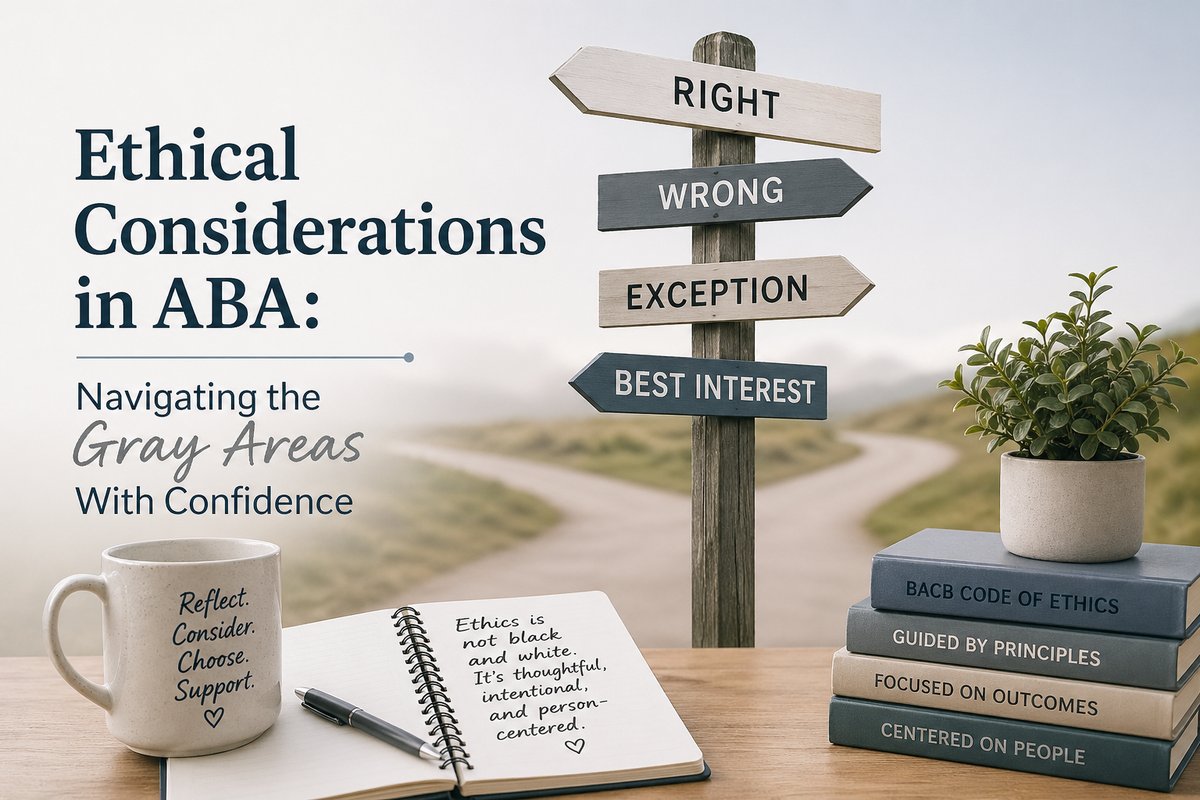
If you've been practicing in ABA for any length of time, you've probably found yourself in a situation where the "right" thing to do wasn't immediately obvious. Maybe a parent asked you to target a behavior that didn't quite sit right with you clinically. Maybe you felt pressure to keep a client on your caseload longer than seemed necessary. Maybe you noticed a colleague doing something questionable and weren't sure how to handle it. These moments are more common than we tend to admit. And here's the thing: the BACB's Ethics Code for Behavior Analysts gives us an excellent foundation, but it can't anticipate every scenario we'll encounter. Real-world ethical practice requires something more than memorizing a document. It requires ongoing reflection, honest conversation, and a willingness to sit with discomfort when the answers aren't clear-cut.
So let's talk about some of the ethical gray areas that come up frequently in ABA, and how we can approach them thoughtfully.
When most of us studied ethics during our coursework or exam prep, it felt relatively straightforward. You read a scenario, you identified the relevant code, you picked the best answer. But practice doesn't work like a multiple-choice test. In the real world, ethical dilemmas often involve competing values, limited information, and real human relationships that make things complicated. For example, the Ethics Code emphasizes client autonomy and the right to effective treatment. But what happens when a parent's goals for their child conflict with what the data suggest is the most beneficial direction? What happens when an insurance authorization limits the scope of what you can provide, even though you know the learner needs more? These aren't hypothetical questions. The point isn't that the Ethics Code fails us. It doesn't. But it's designed to be a guide, not a script. And becoming a skilled ethical practitioner means developing the judgment to apply those principles in context.
One of the most important shifts in our field over the past several years has been the growing emphasis on client assent. The updated Ethics Code explicitly addresses this, and for good reason. For a long time, the focus in ABA was heavily on consent from caregivers and authorization from funding sources. The learner's own experience during treatment didn't always get the attention it deserved. Assent means paying attention to whether the individual we're working with is a willing participant in what we're doing. And for many of our learners, especially those who are pre-verbal or have limited communication, assent doesn't look like a signed form. It looks like body language. It looks like approach or avoidance behavior. It looks like a child turning away, pushing materials aside, or becoming visibly distressed. I think most practitioners have good intentions here. But it's worth asking ourselves honestly: are we always watching for signs of dissent? Or do we sometimes push through because the program says so, or because we feel pressure to show progress?
A few practical things you can do:
Build choice into sessions whenever possible. Let the learner pick materials, activities, or the order of tasks.
Establish clear "break" or "stop" signals that the learner can use, and honor them consistently.
Regularly check in with yourself and your team: would I be comfortable if this session were being observed by the learner's family? By a peer? By an ethics board?
Document not just what you taught, but how the learner responded to the teaching context itself.
This one comes up a lot, and I think it deserves more attention than it typically gets. Social validity refers to whether the goals we're targeting, the procedures we're using, and the outcomes we're achieving are meaningful and acceptable to the people involved, especially the learner and their family. It's easy to fall into the trap of targeting skills because they're easy to measure or because they fit neatly into a curriculum. But if a skill doesn't improve the learner's quality of life, increase their independence, or matter to the people who know them best, we need to ask ourselves why we're targeting it. Wolf's 1978 paper on social validity (https://onlinelibrary.wiley.com/doi/10.1901/jaba.1978.11-203) is still incredibly relevant here. He argued that if society doesn't value what we're doing, then our work won't survive, no matter how technically sound it is. That message is more important now than ever, as our field faces increased scrutiny from autistic self-advocates and disability rights communities.
Some questions worth sitting with:
Did the family have meaningful input into the goals on this treatment plan, or did we just present goals for them to sign off on?
Is this skill something the learner will actually use in their daily life?
Are we targeting the reduction of a behavior because it's genuinely harmful or limiting, or because it makes other people uncomfortable?
Have we considered the learner's cultural and family context when selecting goals?
ABA is a uniquely intimate field. We're often in people's homes. We work with families during some of the most vulnerable and emotionally intense periods of their lives. It's natural that relationships develop, and that the line between "professional" and "personal" can start to feel blurry. The Ethics Code addresses multiple relationships and conflicts of interest, but the reality is that these situations are rarely black and white. A parent invites you to their child's birthday party. A family offers you a generous gift at the holidays. A former client's parent reaches out to you on social media. None of these are inherently unethical, but each one requires careful thought. The guiding question I always come back to is this: could this relationship, or the perception of this relationship, compromise my clinical judgment or the quality of services I'm providing? If the answer is yes, or even maybe, it's worth pausing and consulting with a colleague or supervisor.
This might be the most uncomfortable ethical territory of all. You observe a colleague using a procedure that seems overly restrictive. You hear about a supervisor who isn't providing adequate oversight. You notice that a company's billing practices don't quite add up. The Ethics Code is clear that we have a responsibility to address ethical violations. But knowing that and actually doing it are two very different things, especially when there are power dynamics, employment concerns, or personal relationships involved.
Here's what I'd encourage:
Start with a direct conversation when it's safe and appropriate to do so. Many ethical concerns stem from lack of training or awareness, not malicious intent.
Document what you've observed, factually and without interpretation.
Consult with a trusted mentor or colleague. You don't have to navigate this alone.
If direct resolution isn't possible or the concern is serious, report to the appropriate body (the BACB, a licensing board, or a supervisor up the chain).
Some things that help build that culture:
Regular ethics discussions in team meetings (not just annual CEU trainings).
A supervision structure where questions and concerns are welcomed, not punished.
Leadership that models ethical decision-making transparently.
Access to the Ethics Code and related resources as living documents, not binder fillers.
I've found that when teams normalize talking about ethical gray areas, people are more likely to speak up early, before small concerns become big problems.
Ethics in ABA isn't about perfection. None of us will get it right every single time. What matters is that we're thinking critically, consulting with others, centering our learners, and being willing to course-correct when we realize we've missed the mark. The gray areas can feel uncomfortable. But they're also where some of the most important growth happens, both for us as practitioners and for the field as a whole. So lean into those moments. Ask the hard questions. And remember that ethical practice, at its core, is about doing right by the people who trust us with their care.
Written by
Liz Maher
Liz Maher, MEd, BCBA, is an experienced Board Certified Behavior Analyst who provides consulting services to educational institutions and is the parent of a young adult with autism.
Explore our resources and training programs for ABA professionals, educators, and parents.