
It's the Match That Matters: Reinforcing Honest Self-Monitoring with Self & Match
Oct 13, 2026

Liz Maher
April 1, 2026
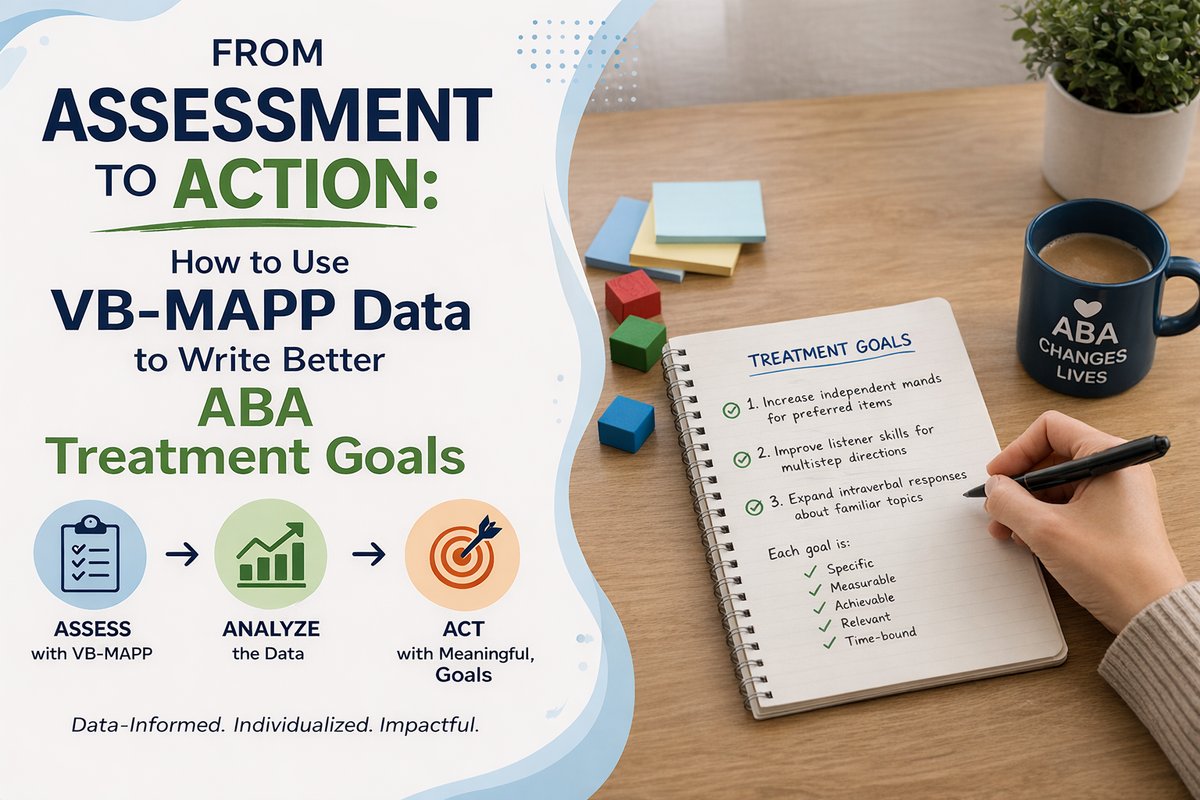
If you’ve been in the ABA field for a while, you’ve probably experienced this (I know I have): you complete a really thorough VB-MAPP, you’ve got all this great data… and then when it comes time to write goals, it doesn’t always feel as connected as it could be. There can be a bit of a gap between assessment and action—and honestly, that’s more common than we tend to talk about.
The VB-MAPP gives us so much information. It’s more than just a snapshot of what a learner can and can’t do—it’s really a roadmap. And like any roadmap, it’s most helpful when we take the time to read it and use it to guide where we’re going next. So let’s talk about how to turn that data into goals that feel meaningful, individualized, and clinically solid.
One thing that can get a little lost—especially when you’re newer in the field—is that finishing a VB-MAPP isn’t the end point. It’s actually the beginning.
Dr. Sundberg designed it to be more than a checklist. It’s a criterion-referenced tool with built-in guidance, which means it’s already pointing you toward next steps—you just have to lean into what it’s showing you.
When you look at a completed Milestones Assessment, try to think beyond the scores and look at the profile. Where are the strengths? Where are the areas that need more support? Is a learner strong in tacting but still developing intraverbals? Are they manding with single words but not yet combining? Those patterns are where your goals start to take shape.
For example, imagine a learner scoring solidly in Level 2 across most domains, but intraverbals haven’t really emerged yet. That’s helpful information. It tells you there’s a relative strength in other verbal operants, and intraverbals may need more focused attention. At the same time, it might also mean some prerequisite skills aren’t quite fluent yet—and it could make sense to strengthen those before jumping fully into intraverbals. And a quick reminder we all need sometimes: just because a milestone has met criteria doesn’t mean it’s “done.” Skills still need to be maintained, generalized, and strengthened over time. Your goals can (and should) reflect that. This is also where it’s helpful to zoom out a bit. The Barriers Assessment is just as important as the Milestones, but it’s easy to overlook. A learner might have strong milestone scores, but if things like prompt dependency, scrolling, or low motivation are showing up, those can impact progress across the board. It’s not about doing anything “wrong”—it’s just about making sure those barriers are part of the plan too, so your skill goals have the best chance of being successful.
The Transition Assessment is another piece that can be really helpful when thinking about goals, especially for learners moving toward more independence.
If a learner is approaching Level 3, this section can give you insight into things like group learning, peer interaction, and independence. For example, a learner might be able to acquire new skills quickly, but struggle in group settings. That’s a great cue to start incorporating goals around group responding, waiting, or peer engagement—not just adding more language targets.
When you’re sitting down to write goals, it can help to keep a simple framework in mind: Look at the whole picture. Milestones, Barriers, and Transition all work together. Notice patterns. Where are the strengths and discrepancies?
Prioritize thoughtfully. Focus on what will make the biggest difference day-to-day and what removes barriers to learning. Not every gap needs to become a goal right away. For example, a learner who isn’t yet manding for basic needs likely has a more immediate priority than expanding a large tact repertoire. And that key idea again: meeting criteria doesn’t equal mastery. A skill is really “there” when it’s fluent, generalized, and happening with minimal teaching.
Use the VB-MAPP’s suggested objectives. They’re incredibly helpful and often underused.
Write goals based on function. Think in terms of verbal operants, not just what the response looks like.
Keep it flexible. As you reassess, your goals should evolve too.
The VB-MAPP gives you a strong framework—but it’s not meant to be one-size-fits-all. Two learners can have very similar scores and still need very different programs based on their barriers, motivation, and real-life contexts.
That’s where your clinical judgment comes in. The VB-MAPP provides the data, and you bring the interpretation. That combination is what leads to meaningful progress.
One thing we’ve really focused on with the VB-MAPP App is helping make that transition from assessment to programming feel smoother.
When your data is organized and visual, it’s just easier to see patterns, track progress, and make decisions. We’ve heard from BCBAs that simply being able to see the full profile more clearly has helped them feel more confident in their goal writing—and that’s really what it’s all about.
We’ve also added a Program Book feature for each learner as part of our organizational analytics tools. After an assessment, AI can suggest programs to prioritize, along with objectives, teaching procedures, and S.M.A.R.T. IEP goals.
It’s completely editable and meant to give you a starting point—something to build from and individualize, not something to replace your clinical decision-making.
At DataMTD, our goal has always been to create tools that help you spend more time with your learners and less time on paperwork.
At the end of the day, the VB-MAPP is only as powerful as how we use it. And the good news is—it already gives us everything we need.
When you take the time to look at the full picture—milestones, barriers, transitions—and let that guide your decisions, your goals naturally become more aligned and more meaningful.
So next time you wrap up a VB-MAPP, take a few extra minutes to really sit with the data. Look for the patterns, think about the learner in front of you, and let that guide your next steps.
That’s where the real impact happens.
Written by
Liz Maher
Liz Maher, MEd, BCBA, is an experienced Board Certified Behavior Analyst who provides consulting services to educational institutions and is the parent of a young adult with autism.
Explore our resources and training programs for ABA professionals, educators, and parents.