
It's the Match That Matters: Reinforcing Honest Self-Monitoring with Self & Match
Oct 13, 2026

Liz Maher
June 15, 2026
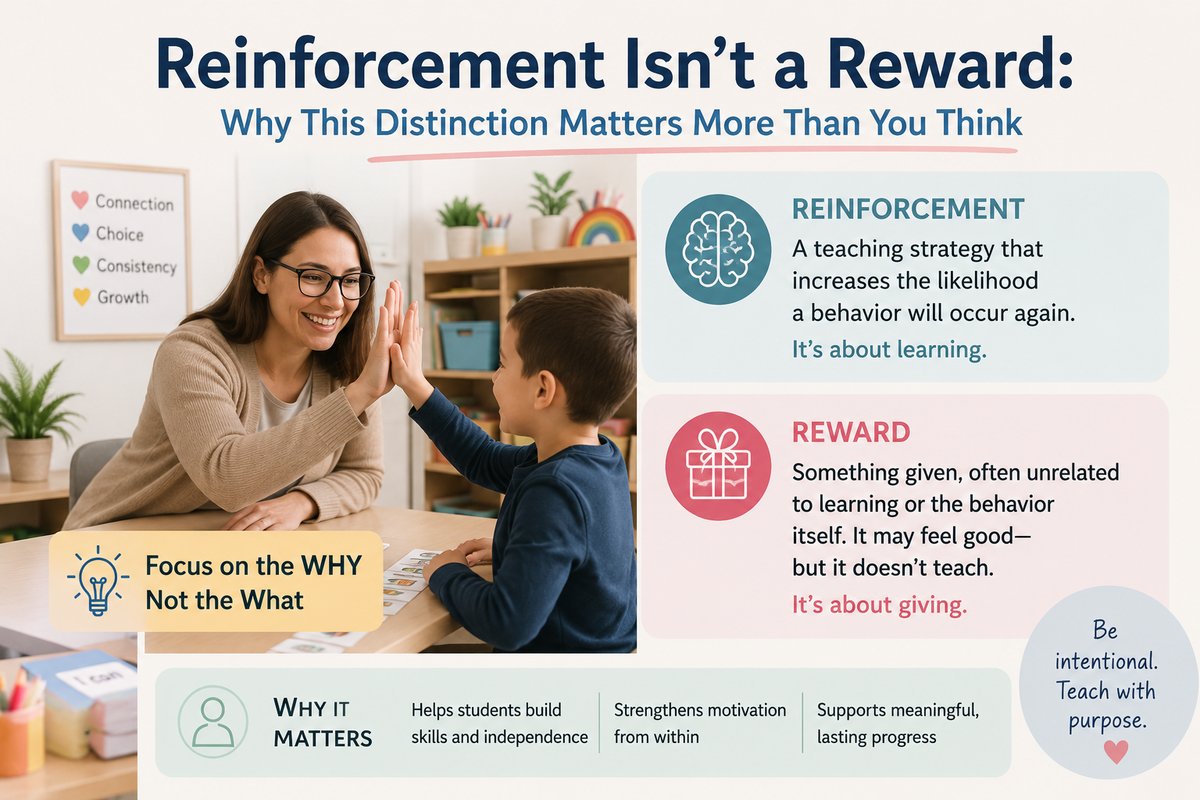
If I had a dollar for every time I heard someone use the words "reinforcement" and "reward" interchangeably, I'd have enough to fund a pretty solid continuing education budget. And honestly, I get it. In everyday language, they sound like the same thing. You give someone something nice after they do something good. Simple, right?
But here's the problem: when we treat reinforcement like it's just a fancy word for "reward," we lose something critical. We lose the precision that makes ABA effective. We start making assumptions about what should work instead of looking at what actually does. And we end up with programs that look great on paper but don't produce meaningful behavior change.
So let's break this down. Because this distinction isn't just academic. It has real, practical implications for how we design interventions, select consequences, and talk about our work with families, teachers, and other professionals.
Let's start with the basics. In behavior analysis, reinforcement is defined by its effect on behavior. A stimulus is a reinforcer if, and only if, it increases the future probability of the behavior it follows. That's it. That's the whole definition. It's functional, not topographical.
A reward, on the other hand, is something given with the intention of being pleasant or motivating. It's defined by the giver's intent, not by the effect on behavior. You can reward someone all day long without reinforcing anything. And you can reinforce behavior with things that nobody would call a "reward" in everyday conversation.
Here's a quick example. A teacher gives a student a sticker every time they complete a math worksheet. The teacher calls it a reinforcer. But the student's worksheet completion doesn't increase. In fact, it stays exactly the same. Is the sticker a reinforcer? No. It's a reward that isn't functioning as reinforcement. The distinction matters because if we call it reinforcement and move on, we miss the fact that our intervention isn't working. We stop asking the important question: what would actually function as a reinforcer for this learner, in this context, right now?
When practitioners blur the line between rewards and reinforcement, a few things tend to go wrong:
We assume instead of assess. We pick consequences based on what we think the learner should like (stickers, praise, tokens) rather than conducting a proper preference assessment or analyzing the data to see if the consequence is actually working.
We blame the learner when programs stall. If we believe we're providing reinforcement but behavior isn't changing, the temptation is to say the learner is "unmotivated" or "non-compliant." In reality, we just haven't identified an effective reinforcer yet.
We create confusion with caregivers and other professionals. When we tell parents, "We use reinforcement," and they hear, "You give kids treats for doing what they're supposed to do," we've already lost the conversation. The misunderstanding feeds into criticisms of ABA that paint it as bribery or as overly reliant on external motivation.
None of these problems are unsolvable. But they all start with the same root issue: imprecise language leading to imprecise practice.
If reinforcement is defined by its effect, then we can't know what's reinforcing until we test it. This is why preference assessments exist. And yet, it's surprising how often they get skipped or treated as a one-time formality done during the initial assessment and never revisited.
Preferences shift. What was highly preferred last month might be neutral today. A learner who was motivated by iPad access in October might be completely satiated on it by December. A child who didn't care about social praise at the start of services might now find it deeply reinforcing after months of effective pairing.
Conducting regular preference assessments, whether formal (paired stimulus, multiple stimulus without replacement) or informal (free operant observation, caregiver interview), keeps your programming grounded in what's actually working. It also communicates respect for the learner. You're saying, "I'm not going to assume I know what you want. I'm going to ask, observe, and adjust."
Here's another layer that gets lost when we think in terms of rewards instead of reinforcement: the role of motivating operations. A stimulus doesn't function as a reinforcer in a vacuum. Its effectiveness depends on the learner's current state.
If a child just had lunch, food is unlikely to function as an effective reinforcer. If a learner has had unlimited access to a toy all morning, offering that toy contingent on a response probably won't do much. This is the concept of satiation, and its counterpart, deprivation, is what establishes something as momentarily more valuable.
When we understand this, we stop thinking about reinforcers as fixed things ("His reinforcer is goldfish crackers") and start thinking about reinforcement as a dynamic process that depends on context, timing, and the learner's current motivation. This is a much more sophisticated and effective way to program.
One of the most important things we can do as practitioners is help families understand this distinction in plain, respectful language. Parents often come in with understandable concerns: "I don't want my child to only do things for a treat." "Isn't this just bribery?" "Shouldn't they learn to do things because it's the right thing to do?"
These are valid concerns, and they deserve thoughtful responses. Here's how I typically frame it:
"Reinforcement isn't about giving your child a prize for doing what they're told. It's about understanding what motivates them right now and using that to help them learn new skills. Over time, the goal is for natural reinforcers, like social interaction, a sense of accomplishment, or access to preferred activities, to maintain the behaviors we're teaching. We start where the learner is and build from there."
When we explain it this way, most parents get it immediately. They recognize that all humans are motivated by consequences. We go to work because of a paycheck. We exercise because of how it makes us feel. We call a friend because the conversation is enjoyable. None of that is bribery. It's how behavior works.
So what does it look like in practice to truly program with reinforcement rather than just dispensing rewards? Here are a few principles:
Let the data decide. If you've delivered a consequence contingent on a target behavior and the behavior isn't increasing, that consequence is not a reinforcer. Period. Adjust accordingly.
Assess preferences regularly. Build brief preference assessments into your routine. Even a quick two-minute free operant observation at the start of a session can give you useful information.
Consider the motivating operation. Before each session or teaching opportunity, ask yourself: what is this learner motivated for right now? What have they been deprived of? What are they satiated on?
Plan for thinning and fading. Effective reinforcement programming includes a plan for gradually shifting from contrived reinforcers to more natural ones. If you're still delivering the same dense schedule of tangible reinforcement six months into a program, it's time to reassess.
Match the reinforcer to the response effort. Harder tasks or newer skills may require more potent reinforcers. Easy, well-established skills can often be maintained with leaner, more natural consequences.
I know this might seem like a small thing. It's just a word, right? But in a field built on the precise analysis of behavior, our language shapes our thinking, and our thinking shapes our practice. When we say "reinforcement," we should mean it in the technical sense: a consequence that demonstrably increases behavior. When we say "reward," we should recognize that we're talking about something else entirely, something defined by intent rather than function.
Getting this right makes us better clinicians. It makes our programs more effective. It helps us communicate more clearly with families and colleagues. And ultimately, it leads to better outcomes for the learners we serve. Because at the end of the day, that's what all of this precision is for. Not to be pedantic, but to be effective.
Written by
Liz Maher
Liz Maher, MEd, BCBA, is an experienced Board Certified Behavior Analyst who provides consulting services to educational institutions and is the parent of a young adult with autism.
Explore our resources and training programs for ABA professionals, educators, and parents.