"What You Hold Up Matters: Selecting Stimuli for the VB-MAPP"
Oct 5, 2026

Liz Maher
August 6, 2026
Here's a scenario that might sound familiar. A learner masters a target. You hit criterion, and you move the skill to "mastered" status. You update the program, introduce a new target, and keep pushing forward. Everyone feels good. The data looks great. Progress is happening.
Then, three weeks later, you probe that "mastered" skill and the learner looks at you like they've never seen it before.
If you've been in this field for more than a few months, you've experienced this. And if you're honest with yourself, you know it happens more often than any of us would like to admit. Skills that were supposedly acquired seem to vanish. Targets that took weeks to teach need to be retaught from scratch. And the question nobody wants to ask out loud starts creeping in: did the learner ever really "have" that skill in the first place?
The answer, in many cases, is that the skill was acquired but never truly maintained. And that's not the learner's failure. That's a programming failure.
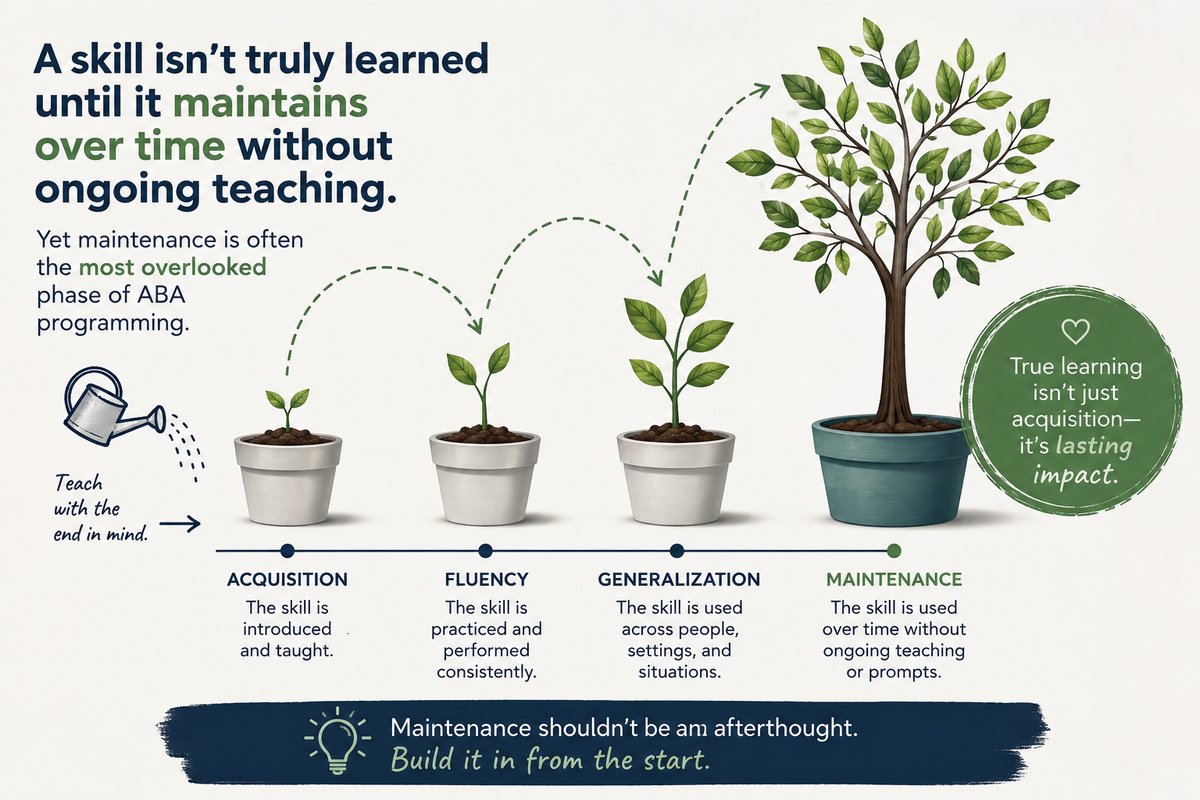
In behavior analysis, maintenance refers to the continued performance of a behavior after some or all of the conditions responsible for its acquisition have been removed. The teaching prompts are gone. The dense reinforcement schedule has been thinned. The structured teaching trials have ended. And the behavior still occurs at acceptable levels when the relevant conditions arise.
That last part is critical. Maintenance isn't just about whether a learner can perform a skill when you test them on it. It's about whether the skill continues to occur functionally, in context, over time. A learner who can label "dog" during a probe but never spontaneously labels dogs in the park hasn't truly maintained the skill in any meaningful way.
Cooper, Heron, and Heward describe maintenance as one of the defining features of effective behavior change. If a behavior doesn't maintain, we haven't really changed anything. We've just temporarily influenced responding under very specific conditions. And while that might look good in session data, it doesn't translate to real-world outcomes for the learner or their family.
Let's be honest about why this happens. There are structural and systemic reasons that maintenance often falls to the bottom of the priority list.
First, there's the pressure to show acquisition. Funding sources, supervisors, and families often want to see new skills being taught and mastered. The metrics we report on tend to emphasize how many targets were mastered in a given period. Rarely does anyone ask, "How many previously mastered skills are still intact?" The incentive structure in many clinical settings rewards forward movement, not durability.
Second, maintenance isn't as exciting to program for. Writing acquisition programs is engaging. You're selecting targets, choosing prompt hierarchies, designing teaching procedures. Maintenance programming, by contrast, can feel repetitive or unclear. What does a "maintenance program" even look like? How often do you probe? When do you stop? These questions don't always have clean answers, and that ambiguity can lead to avoidance. But in reality, maintenance shouldn't be something we think about after teaching—it should drive what we teach from the very beginning. We should start by looking at the learner's everyday environment and asking, What does this learner need to know to be successful here? Then we build our acquisition programs around those skills. When we teach with that perspective, maintenance is already built into the program; we're simply verifying that the learner continues to use those skills over time.
Third, session time is limited. When you have 10 or 15 active acquisition targets and only a few hours per session, it can feel impossible to also cycle through previously mastered skills. Something has to give, and maintenance probes are usually the first thing cut.
But here's the reality: if skills don't maintain, the time spent teaching them was largely wasted. Every target that needs to be retaught is time taken away from new learning. Maintenance isn't a luxury. It's what makes acquisition meaningful.
The good news is that maintenance doesn't have to be an afterthought. With some intentional planning, you can build it into your programs from the beginning. Here are several strategies that make a real difference.
One of the most common reasons skills fail to maintain is that the reinforcement schedule during acquisition was too dense and was never systematically thinned. If a learner only performs a skill when they receive immediate, continuous reinforcement, they haven't learned the skill in a way that will survive the natural environment.
Before calling a target "mastered," consider whether the learner can perform it under thinner, more naturalistic reinforcement conditions. Can they respond correctly when reinforcement is intermittent? Can they tolerate a brief delay? If not, you may be mastering too early.
Create a schedule for probing previously mastered skills. This doesn't have to be complicated. Many clinicians use a rotating probe system where a subset of mastered targets is assessed each session or each week. If a skill falls below criterion during a probe, it gets cycled back into active teaching before too much time passes.
A common framework looks like this:
Probe within 1 week of mastery
Probe again at 2 weeks
Probe again at 1 month
If the skill holds at all three points, move to quarterly checks
The specific intervals matter less than having a system at all. The worst approach is no probing, which is unfortunately the default in many programs.
Skills are most likely to maintain when they contact natural reinforcement in the learner's everyday environment. A child who learns to request "juice" and consistently gets juice from caregivers is contacting a natural contingency that will maintain the response without any programmed reinforcement from a therapist.
When selecting targets and designing programs, ask yourself: what will maintain this behavior once I'm no longer teaching it? If the answer is "nothing," you either need to arrange environmental supports or reconsider whether the target is functional for that learner.
Skills taught under highly controlled, invariant conditions are more fragile. If a learner only ever labels "dog" when sitting at a table with one specific therapist using one specific set of flashcards, the skill is unlikely to survive outside those narrow conditions.
This connects directly to generalization (which we've discussed in a previous post), but it also impacts maintenance. The more varied the conditions under which a skill is acquired, the more robust it tends to be over time. Use multiple exemplars, multiple settings, and multiple instructors during acquisition, and you'll find that maintenance comes more naturally.
One of the simplest and most effective maintenance strategies is to weave previously mastered targets into current teaching sessions. Intersperse easy, known targets among new acquisition targets. This serves multiple purposes: it provides maintenance opportunities, it increases the learner's rate of reinforcement during sessions, and it builds fluency.
This is sometimes called "interspersal" or "mixed-VB" programming, and it's a natural fit for most session structures. Instead of treating mastered skills as "done," treat them as part of the learner's active repertoire that gets exercised regularly.
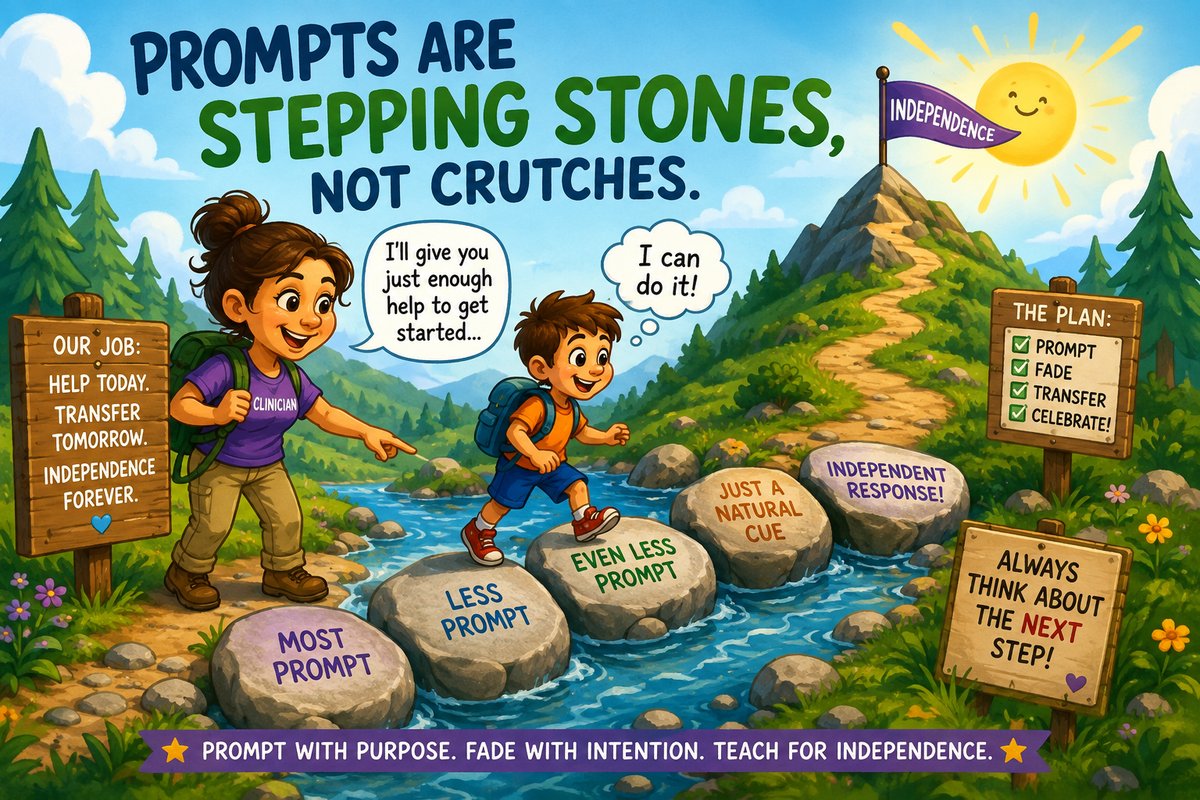
When a skill fails a maintenance probe, resist the urge to simply reteach it the same way. Instead, ask why it didn't maintain. Some common reasons include:
The skill was prompt-dependent during acquisition and never truly under stimulus control
The reinforcement schedule was never thinned
The skill doesn't contact any natural reinforcement in the learner's environment
The skill was taught in conditions too narrow to support generalized responding
The mastery criterion was too lenient
Each of these points requires different solution. Sometimes you need to reteach with better prompt fading. Sometimes you need to arrange environmental supports. Sometimes you need to adjust your mastery criteria going forward. The key is to treat maintenance failures as data, not as mysteries.
Ultimately, this comes down to how we define success in our programs. If mastery means "hit criterion in session," we're setting a low bar. If mastery means "the learner can perform this skill independently, across settings and people, over time, without ongoing teaching," then we're holding ourselves to a standard that actually matters for the learner's life.
That second definition is harder to achieve. It takes more planning, more probing, and more willingness to slow down acquisition in favor of durability. But it's the definition that leads to real, lasting outcomes.
The next time you move a target to "mastered," ask yourself: will this skill still be there in a month? If you're not confident the answer is yes, it might not be time to move on just yet.
Written by
Liz Maher
Liz Maher, MEd, BCBA, is an experienced Board Certified Behavior Analyst who provides consulting services to educational institutions and is the parent of a young adult with autism.
Explore our resources and training programs for ABA professionals, educators, and parents.