It's the Match That Matters: Reinforcing Honest Self-Monitoring with Self & Match
Oct 13, 2026
Liz Maher
October 5, 2026
When we administer the VB-MAPP, the materials we hold up often get less attention than the milestones. But the materials are part of the test. If the stimulus is not right, the score may not tell us what we think it tells us.
As lead clinician for DataMTD, I see this often. A learner "passes" a tact with flashcards, then cannot name the same item at home. Or a learner "fails" an item they know well, because the picture did not look like anything they recognized. Here is how I think about materials, drawing on the Program Book and the VB-MAPP Guide in the VB-MAPP App, plus some clinical practice of my own.
The VB-MAPP Guide in the app notes that many testing materials can come straight from the classroom or home, and that assessment can happen in natural settings like a playroom, playground, yard, or park. For early Level 1 skills, the Guide points to common objects the child contacts daily, such as a toothbrush, cup, spoon, ball, or stuffed animal, along with pictures of family, pets, and familiar items.
The milestone materials follow the same pattern. Early tact milestones use common items in the natural environment, including pictures, and Listener 5-M uses arrays of common items like a hat, book, spoon, and ball.
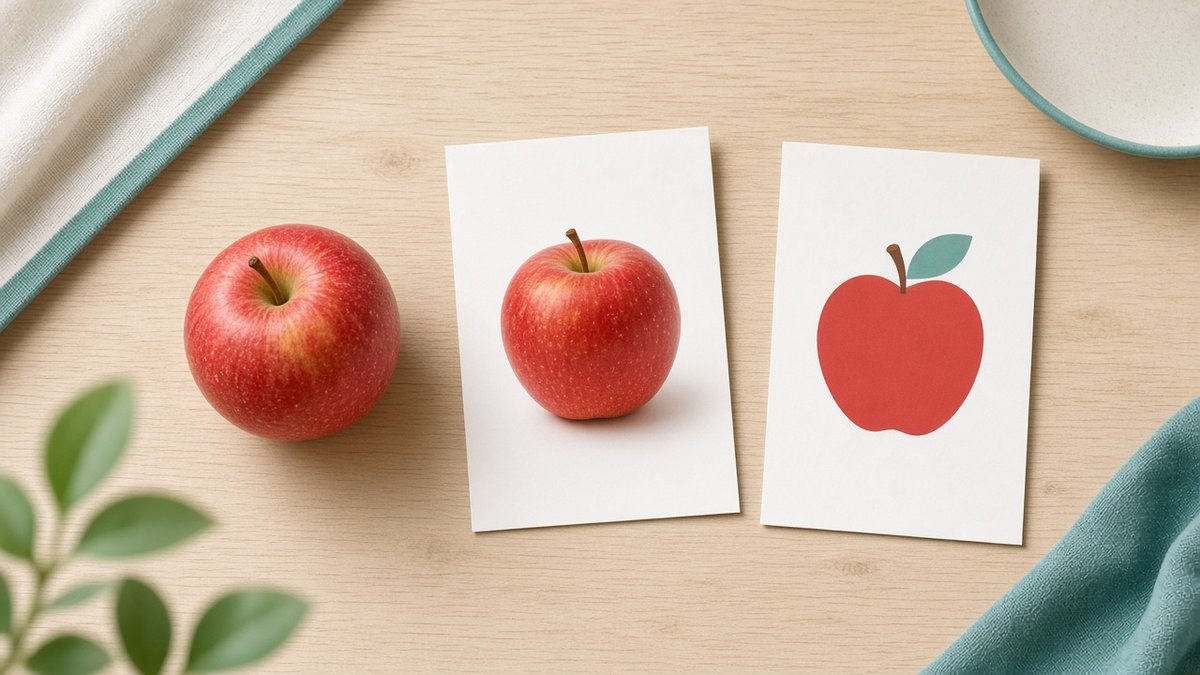
In my clinical practice, I find it helpful to think about those stimulus types as a progression for noun identification, both tacting and listener responding:
Real objects. The learner's actual cup or shoe. These are closest to what the learner meets every day.
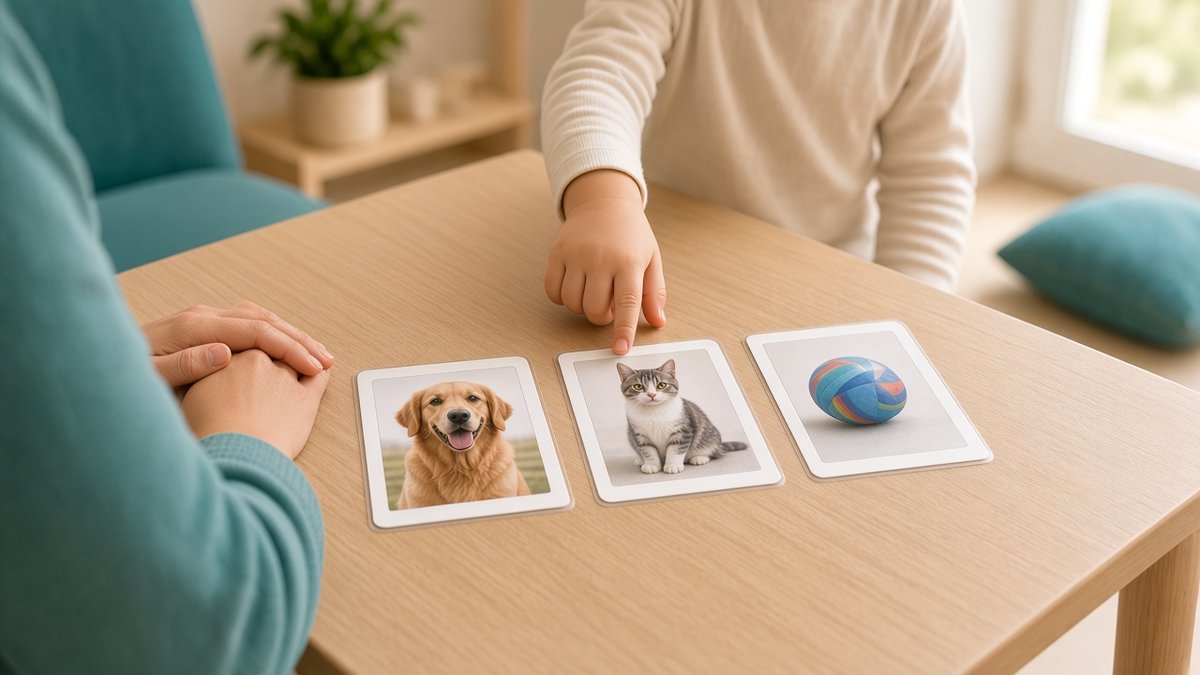
Realistic photos. Clear photographs of the same or similar items, one per photo, on a plain background.
More abstract pictures. Clip art, illustrations, and line drawings, as appropriate.
Each step moves further from the real thing. If a learner misses a line drawing, the gap could be vocabulary or abstraction. Moving from objects toward pictures helps separate the two. Record the format you used.
This is the point I want to stress most: printed words should not appear on the cards or pictures you use to test tacting or listener responding.
Many commercial flashcards print the item's name under the picture. If "apple" is on the card, a learner who reads, or who has learned to respond to the shape of that word, may be responding to the text, not the picture. That is textual behavior (reading), not tacting or identifying.
The result can look like an item skill but actually be a reading skill. Some learners are strong early readers, and even partial control by a printed word inflates a score. It is worth noting that the VB-MAPP Guide places sight words paired with pictures at Level 3 as a reading-related skill. Reading is its own repertoire, and it deserves its own assessment.
If your cards have words, cover them, cut them off, or replace the set.
The Program Book opens its programs with a reminder that applies here too: "Program recommendations are a starting point for planning and should always be individualized for the learner." The mastery guidance says the same about criteria, noting that mastery "requires fluency, minimal teaching, and generalization to novelty."
In practice, that means:
Use the reinforcer survey to learn the learner's interests, and use it to pick items for mand, tact, and listener testing, as the app's tester tips suggest.
Include preferred and novel items that are age-typical, and gender-neutral or gender-specific as appropriate.
Choose items from the learner's real home, school, culture, and community. A learner who drinks from a sippy cup may not recognize a teacup.
Individualizing does not make the assessment less rigorous. It makes it more accurate.
The object, photo, picture progression works well for nouns. It is not the right approach for actions or noun-verb combinations.
Actions are ongoing events, and a still picture shows only a frozen moment. The app's materials guidance for Tact 8-M reflects this: "Use common moving stimuli in the child's natural environment, or contrive them in a testing situation." The examples include jumping or rolling a ball while asking, "What am I doing?" Tact 9-M noun-verb examples also involve ongoing movement, like a jumping monkey or someone pulling a wagon.
So for assessing and teaching actions:
Use real, ongoing actions whenever possible. Clap, jump, or pour while the learner watches.
Use short video clips when live demonstration is not practical. A video is a practical way to present moving stimuli when you cannot act them out.
In my practice, I treat still pictures of actions as a later generalization check. Once a learner reliably tacts actions shown live or on video, we can ask a new question: can the learner infer that a still picture represents the same action they already know? If they see a child on a swing and say "swinging," they understand the picture stands for the ongoing event. It is a valuable skill, but it builds on the action repertoire. It is not the format for the initial test.
Before your next assessment, check your kit:
Start with common objects in the natural environment.
For nouns, move from real objects to photos to more abstract pictures, and test across stimulus types.
Remove printed words from every card and picture.
Individualize materials to the learner's life and interests.
Use moving stimuli, live or on video, for actions and noun-verbs.
Save still pictures of actions for later generalization.
The Program Book and VB-MAPP Guide in the authorized VB-MAPP App are good places to check materials suggestions as you plan each assessment.
Written by
Liz Maher
Liz Maher, MEd, BCBA, is an experienced Board Certified Behavior Analyst who provides consulting services to educational institutions and is the parent of a young adult with autism.
Explore our resources and training programs for ABA professionals, educators, and parents.