
It's the Match That Matters: Reinforcing Honest Self-Monitoring with Self & Match
Oct 13, 2026

Liz Maher
August 10, 2026
You've been there. The learner can tact "car" perfectly during structured sessions at the table. Flash card up, response out, reinforcement delivered. The data shows mastery. The graph looks beautiful. Everyone is thrilled.
Then you take that same learner to the window, point to an actual car in the parking lot, and ask, "What's that?" Nothing. Or they look around for the flash cards. Or they don't respond unless the therapist presents the materials in exactly the same way as during teaching.
At first glance, this might look like a stimulus control problem. But there's an important distinction: if the learner learned to tact "car" correctly in the teaching setting but simply hasn't learned to use that skill with different exemplars, people, materials, or environments, this is primarily a generalization problem.
Now consider a different example.
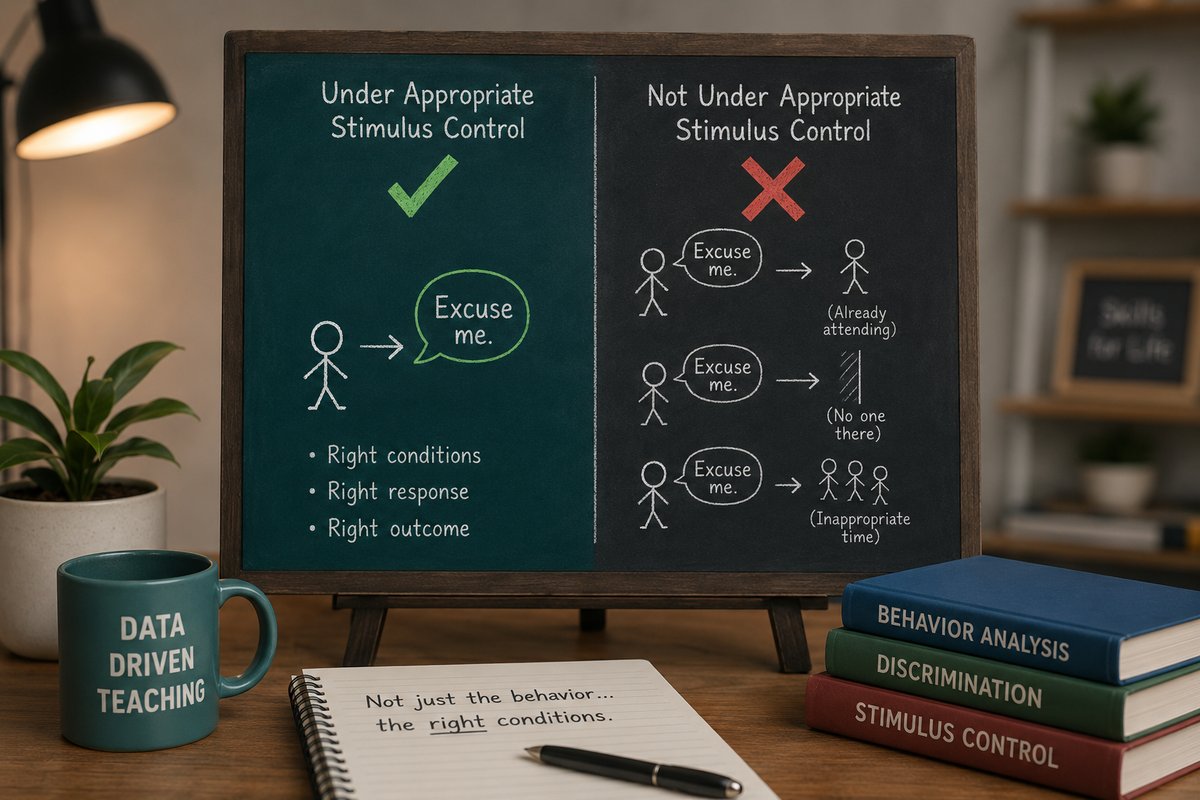
A learner has been taught to say "excuse me" to get someone's attention. Great skill. Socially appropriate. Functionally relevant. Except now they say "excuse me" 40 times in a row. They say it when you're already looking at them. They say it to the wall. They say it when the person is actively talking to someone else. They say it during a fire drill.
Here, the problem is different. The learner has the behavior in their repertoire, but the response isn't occurring under the appropriate stimulus control. The learner hasn't learned to discriminate the conditions under which "excuse me" should and should not be emitted. And that distinction — the difference between a behavior being in a learner's repertoire, being generalized across conditions, and being under the control of the right environmental variables — is one of the most important and frequently overlooked concepts in effective ABA programming.
Stimulus control exists when a behavior occurs reliably in the presence of a particular stimulus or set of conditions and does not occur, or occurs at a much lower rate, in the absence of those conditions.
In other words, the behavior is "under the control" of the antecedent variables that should evoke it. Cooper, Heron, and Heward describe stimulus control in terms of responding that occurs differentially in the presence of an SD (discriminative stimulus) and not in the presence of an SΔ (S-delta). The SD signals that a particular response is likely to contact reinforcement, while the SΔ signals that the same response is unlikely to contact reinforcement. In practical terms, we want the learner to respond when the relevant conditions are present and withhold that response when they are not. In practical terms, we want the learner to respond when the relevant conditions are present and withhold that response when they are not. Consider the "excuse me" example. The learner should say "excuse me" when they need to gain someone's attention and the relevant conditions are present. They should not say "excuse me" simply because a person is nearby, because they have learned that the phrase produces attention, or because they have learned to emit it at a particular point in an interaction. The goal isn't simply to teach the response. The goal is to teach when the response is appropriate. When stimulus control is well established, the learner's behavior is reliably influenced by the relevant environmental variables. When it isn't, responses may occur too broadly, too narrowly, or in response to irrelevant features of the environment.
This is where things can get confusing.
A learner who can tact "car" from flashcards but doesn't tact a car in the parking lot may have a generalization problem. The learner has learned the response, but the skill hasn't transferred across exemplars or settings.
A learner who says "car" only when a particular flashcard is presented, or only when the therapist holds the card in a particular way, may have a stimulus control problem. The learner may have come under the control of irrelevant features of the teaching arrangement rather than the relevant features of the stimulus. The distinction matters because the intervention is different.
Generalization requires us to arrange teaching so that the behavior transfers across people, settings, materials, examples, and conditions.
Stimulus control requires us to identify what is currently controlling the behavior and arrange teaching so that the right stimulus gains control while irrelevant stimuli lose control.
Sometimes the two problems overlap. In fact, poor stimulus control during acquisition can create what later looks like a generalization problem.
Consider a learner who has been taught to respond "yes" when asked, "Do you want it?" During teaching, the therapist always holds up the preferred item immediately before asking the question. The learner quickly learns to say "yes." But now the therapist asks, "Do you want it?" without holding up the item, and the learner doesn't respond. Or the therapist holds up a completely different item and the learner still says "yes."
What's controlling the response?
Possibly not the question itself. The learner may have learned that the therapist holding up an item — or some other feature of the teaching routine — is the cue to say "yes." The response is in the repertoire, but the wrong stimulus may be controlling it. The same thing can happen with academic tasks, social communication, listener responding, tacting, and virtually any other skill we teach.
A learner might learn to:
Touch the correct picture only when it is presented in a particular position.
Answer a question only when the therapist uses a particular tone of voice.
Follow an instruction only when a specific gesture accompanies it.
Say "excuse me" whenever a person is nearby rather than when attention needs to be gained.
The common thread is that the learner is responding — but not necessarily to the variable we intended to establish as controlling the behavior.
One of the trickiest things about stimulus control issues is that they can masquerade as something else.
A learner who doesn't respond correctly in a new setting might be labeled as "not generalizing."
A learner who responds to everything the same way might be described as "not discriminating."
A learner who performs inconsistently might be seen as "unmotivated," "not attending," or "not ready."
Sometimes those descriptions are accurate. But sometimes we're looking at a stimulus control problem.
The behavior is there.
The question is: What is controlling it?
Stimulus control doesn't go wrong by accident. It develops as a result of the contingencies we arrange during teaching.
Here are some common culprits:
If a therapist always glances at the correct answer before the learner responds, the learner may come under the control of the therapist's eye gaze rather than the actual discriminative stimulus.
The learner looks "correct" during sessions but falls apart when the inadvertent prompt is removed.
This is often described as prompt dependency, but more precisely, the learner's behavior may have come under the control of an unintended stimulus.
When we teach with the same materials, in the same setting, with the same instructor, session after session, we risk bringing behavior under the control of irrelevant contextual features.
The learner may learn more than we intended — not just the response, but the entire teaching routine surrounding it.
If we want the relevant stimulus to control the response, we need to make sure the learner has sufficient exposure to variation while still contacting reinforcement for responding correctly.
If a learner says "excuse me" and gets attention regardless of whether the listener is available, the behavior may begin occurring under increasingly broad stimulus conditions. The learner isn't learning only how to get attention.
They're learning when "excuse me" produces reinforcement. Differential reinforcement matters because it helps establish the appropriate antecedent conditions for the response.
Sometimes we simply don't teach enough "not that" examples. If a learner only ever contacts reinforcement for saying "dog" in the presence of dogs, but rarely experiences situations in which other animals or objects are present and "dog" does not produce reinforcement, we may not be giving the learner enough opportunities to learn the boundaries of the response. Discrimination requires learning both when to respond and when not to respond.
The good news is that stimulus control problems are fixable. The less good news is that fixing them after the fact is usually harder than preventing them in the first place.
Before you can fix the problem, you need to figure out what stimulus or set of conditions the behavior is currently under the control of. Probe systematically. Change one variable at a time. Remove the therapist's prompt. Change the setting. Swap the materials. Alter the irrelevant contextual cues. Present the relevant SD without the usual teaching routine.
You're looking for what makes the behavior appear or disappear.
Don't allow one example to become the definition of the skill. Teach across multiple examples from the beginning. Vary materials, examples, people, positions, and relevant contexts. If you want a learner to tact "dog," for example, teach with many different dogs rather than allowing one picture of one dog to become the stimulus that controls the response. But remember: multiple exemplars alone don't guarantee generalization or appropriate stimulus control.
We also need to make sure the learner is contacting reinforcement for responding to the relevant features of the stimulus.
Don't just teach what to say. Teach when to say it — and when not to say it. Include opportunities to respond in the presence of the relevant SD and opportunities to withhold the response in the presence of an SΔ. For "excuse me," teach conditions in which getting someone's attention is appropriate and conditions in which the person is already attending, the response isn't necessary, or the situation makes the response inappropriate. Reinforce differentially based on the relevant antecedent conditions.
If you suspect the behavior is under the control of your teaching setup rather than the target stimulus, systematically vary and fade those contextual features. Teach at the table, then on the floor, then standing up, then in the hallway. Change materials. Change instructors. Change the position of stimuli. Change the way instructions are delivered. The goal isn't to make teaching unpredictable. It's to make sure the learner's response isn't unnecessarily tied to features that won't be present when the skill is needed.
Don't wait until a skill is "mastered" to see if it transfers. Probe across novel conditions during acquisition. If the learner can perform the skill only under one very specific set of circumstances, you'll catch it early enough to adjust your teaching before an unwanted stimulus-control history becomes deeply established. Prevention Is Always Easier Than Remediation The best stimulus control programs are the ones that never need to be fixed because they were designed correctly from the beginning. That means thinking carefully, before you ever run your first teaching trial, about what you want the behavior to be controlled by.
Not just:
"Can the learner do this?"
But:
"What do I want this behavior to be controlled by?"
And:
"Am I arranging teaching conditions that will produce that outcome?"
Every time you run a teaching trial, you're not just teaching a response. You're establishing a relationship between that response and the conditions under which it occurs. If you're not thoughtful about what those conditions are, the learner will figure it out for you. And they might figure out something you didn't intend.
Stimulus control is not an advanced topic reserved for coursework or journal articles. It's happening in every session, with every learner, on every trial. The question isn't whether stimulus control is developing. It's whether the right stimulus is gaining control. When a learner performs inconsistently, doesn't generalize, or seems to "lose" skills in new environments, resist the urge to immediately blame motivation, attention, or ability. Look at the antecedent. Look at the teaching history. Look at what is actually controlling the behavior. And then fix the programming, not the learner. Because our goal isn't simply to produce a response. It's to produce a response under the right conditions, for the right reason, and across the conditions in which the learner will actually need the skill.
Written by
Liz Maher
Liz Maher, MEd, BCBA, is an experienced Board Certified Behavior Analyst who provides consulting services to educational institutions and is the parent of a young adult with autism.
Explore our resources and training programs for ABA professionals, educators, and parents.