
It's the Match That Matters: Reinforcing Honest Self-Monitoring with Self & Match
Oct 13, 2026

Liz Maher
August 17, 2026
A four-year-old throws himself on the floor every time his tablet is taken away. A seven-year-old hits her peers when they take her preferred toy. A teenager screams and pushes materials off the desk when academic demands get too difficult.
At the surface level, these look like very different problems. Different topographies, different learners, different settings. But underneath all of them is the same basic truth: the learner is communicating something. They want something back. They want something to stop. They want access or escape or attention, and the only tool they have that works reliably is the challenging behavior itself.
This is where Functional Communication Training comes in. And when it's done well, it can be one of the most powerful, most ethical, and most durable interventions in all of ABA.
Functional Communication Training (FCT) is a differential reinforcement procedure in which a learner is taught a communicative response that serves the same function as the challenging behavior. The key word there is same function. You're not just teaching the learner to talk. You're not just giving them a script or a picture card and hoping for the best. You're identifying the reinforcer that has been maintaining the problem behavior and then teaching the learner a new, more appropriate way to access that exact reinforcer.
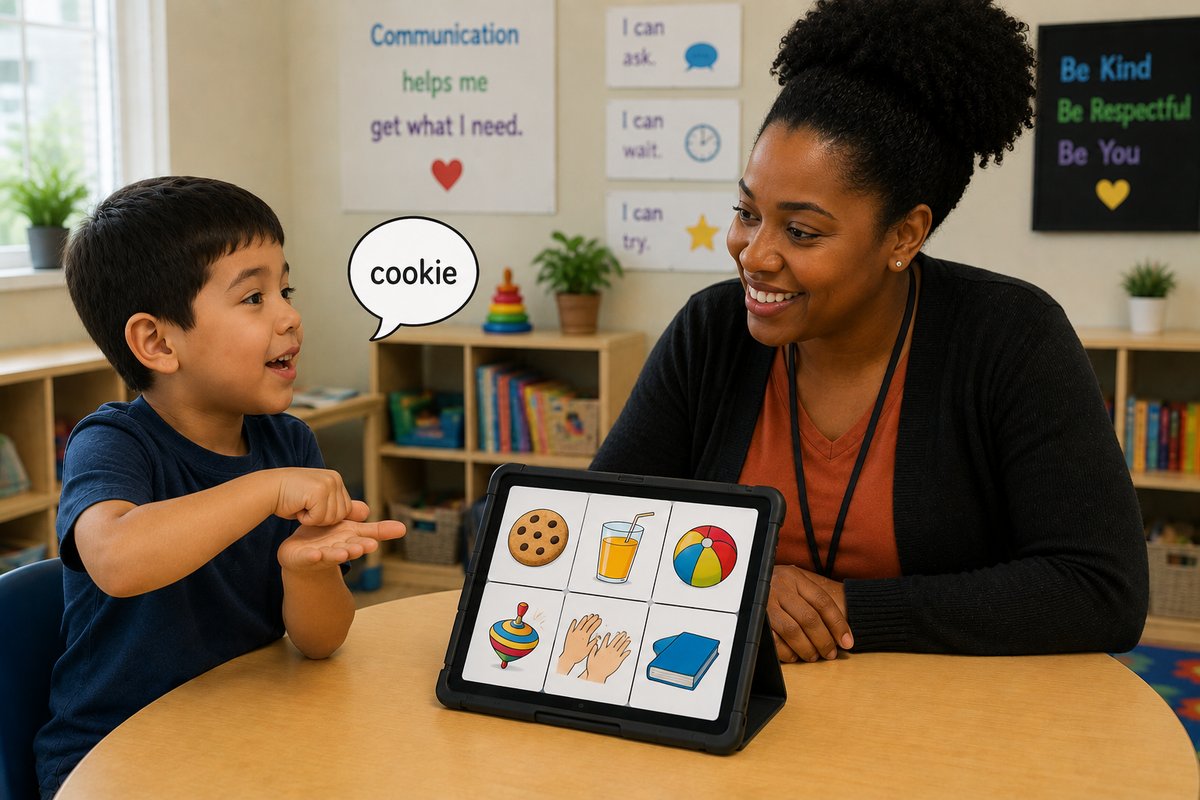
If a learner hits to escape demands, you teach them to request a break. If a learner screams to get attention, you teach them to tap a shoulder or raise a hand. If a learner engages in self-injury to access tangibles, you teach them to ask for the item using whatever modality is most accessible to them.
The logic is elegant: if the new response works better than the old one, the learner will use the new response. Behavior goes where reinforcement flows.
But here's where things get complicated. Because in practice, FCT is far more nuanced than "teach a mand and the problem behavior will go away." And when it's implemented poorly, it can actually make things worse.
The entire foundation of FCT rests on an accurate functional assessment. If you get the function wrong, the replacement behavior you teach won't contact the reinforcer that matters, and the learner will have no reason to use it.
Consider a learner who engages in aggression during circle time. The team assumes the function is escape from the activity, so they teach the learner to request a break. But the aggression continues. Why? Because the actual function was attention from the teacher. The learner didn't want to leave circle time. They wanted the teacher to come over and interact with them. The break card is functionally irrelevant.
This is why a thorough functional behavior assessment (FBA), and in many cases a functional analysis (FA), is not optional before implementing FCT. It is the prerequisite. Without it, you're guessing. And guessing with vulnerable learners is not a clinical luxury we can afford.
Once you have a clear, well-supported hypothesis about the function of the behavior, the next step is selecting and teaching the replacement response. This is where many programs fall short, not because the concept is wrong, but because the details aren't right.
Here are the critical design considerations:
If you're asking a learner to produce a full sentence ("May I please have a break from my work?") when they currently get the same result by flopping on the floor, you've set up an unfair competition. The challenging behavior requires less effort and produces the same outcome. Response effort matters. Start with something simple. A single word, a picture exchange, a gesture, a button press. You can shape complexity later. Right now, you need the learner to use the new response instead of the old one.
In the early stages of FCT, every instance of the communicative response should produce the functional reinforcer. Every single time. If the learner says "break" and you say "just one more minute," you've just taught them that the new response doesn't work. And when the new response doesn't work, the old one comes back. This is not the time for delay tolerance training. That comes later, after the replacement response is strong and fluent.
This is the extinction component of FCT, and it's essential. If aggression still produces escape, and the mand also produces escape, the learner has two paths to the same outcome. There's no reason to abandon the old behavior. For FCT to work, the communicative response must be the only reliable path to the reinforcer. The challenging behavior must be placed on extinction.
This is also where things can get difficult in practice. Extinction bursts are real. Safety concerns are real. And in some settings (schools, homes, community environments), placing severe behavior on full extinction may not be immediately feasible. In those cases, careful planning, environmental modifications, and sometimes a more gradual approach to extinction may be necessary. But the principle remains: the new response must work better than the old one.
If only the BCBA knows that the learner tapping the table twice means "I need a break," the response will fail in every other context. The communicative form you select must be something that parents, teachers, siblings, and peers can recognize and respond to. This is where collaboration and training become non-negotiable parts of the intervention.
Even when the initial design is solid, there are several ways FCT can break down over time:
If the learner can request a break every 30 seconds and receive one every time, you haven't solved the problem. You've just replaced one disruption with another. Schedule thinning (gradually increasing the delay between the request and the reinforcer delivery, or increasing the ratio of demands to breaks) must be planned from the beginning.
If the learner only uses the replacement response with one therapist, in one room, during one activity, you haven't achieved functional communication. You've achieved a parlor trick. Multiple exemplar training, varied settings, and caregiver involvement are essential.
FCT is not a one-week intervention. It requires ongoing monitoring, schedule thinning, tolerance training, and generalization probes over weeks and months. Teams that declare victory after the first week of reduced problem behavior are often surprised when the behavior returns.
Not every learner will use vocal speech. Some will use picture exchange, sign language, speech-generating devices, or gestures. The modality should be chosen based on the learner's current repertoire, motor abilities, and the likelihood that communication partners will respond to it. Forcing vocal speech when a learner has a more accessible option is not evidence-based. It's a bias.
The ultimate goal of FCT is not just to reduce challenging behavior. It's to give the learner a durable, flexible, socially valid way to navigate their world. That means the intervention doesn't end when the behavior decreases. It continues through schedule thinning, delay tolerance training, and teaching the learner to wait, to accept "no" or "not right now," and to use their communication across people, settings, and situations.
But there is an even bigger reason why this matters: communication creates independence.
Imagine a learner who wants their favorite snack but has no reliable way to communicate that desire. They may have to wait for an adult to notice what they want, guess what they are asking for, or engage in behavior that has historically resulted in someone figuring it out. The same is true when they want a preferred activity, need help, want attention, or need something to stop.
Teaching that learner an effective way to communicate changes the equation.
Instead of relying on someone else to interpret their behavior, they can tell us what they want. Instead of waiting for an adult to offer a preferred item, they can request it. Instead of needing someone to recognize that they are overwhelmed, they can ask for a break. Instead of having to depend on another person to anticipate their needs, they have a tool they can use to influence their own environment.
And that matters for something much bigger than behavior reduction: happiness and quality of life.
Being able to successfully communicate that you want something—and then actually getting it—is inherently empowering. So is being able to communicate that you don't want something, that you need help, that you want attention, or that you need a break. These are basic forms of control over our environment that most of us use constantly without thinking about it.
When we teach a learner a functional method of communication that reliably allows them to access their most preferred items, activities, attention, or other meaningful reinforcers, we aren't creating dependence on reinforcement. We're giving them a more effective way to access the things that make their life enjoyable.
The goal should not be for a learner to need an adult to prompt them to communicate every time they want something. The goal is for communication to become a tool they can independently use.
That is a profound shift.
A learner who can independently walk over to their communication device and request their favorite activity has more control over their environment than a learner who must wait for an adult to figure out what they want. A learner who can say "break" when work becomes overwhelming has a safer and more effective option than a learner who has to rely on someone noticing escalating behavior. A learner who can request using adapted signs a favorite food, toy, person, or activity can actively participate in creating moments of enjoyment in their own day.
Functional communication isn't simply replacing a problem behavior with a more appropriate response. It is giving the learner a way to get their needs met without having to depend on others to figure them out.
Hanley, Iwata, and Thompson (2001) demonstrated that FCT with schedule thinning can produce durable reductions in problem behavior while maintaining the communicative response. Tiger, Hanley, and Bruzek (2008) extended this work by showing how tolerance training (teaching learners to accept denied requests without engaging in problem behavior) can be layered onto FCT to produce even more robust outcomes.
These aren't optional add-ons. They're the difference between an intervention that works in a clinic room and one that works in real life.
At its core, FCT is about respect. It acknowledges that challenging behavior is not random, not willful defiance, and not something to be suppressed without offering an alternative. It says to the learner: "I understand what you need. Let me help you get it in a way that works better for everyone."
When we teach a learner to communicate their needs effectively, we're not just reducing a target behavior on a graph. We're giving them agency. We're giving them a voice. And we're building a relationship that says: your needs matter, and I'll help you meet them.
But we should take that one step further.
We're also giving them independence.
We're teaching them that they don't have to wait for someone else to guess what they want. They have a reliable way to ask. They can make things happen in their environment. They can access the people, activities, objects, attention, breaks, and experiences that are meaningful to them.
That ability to communicate and independently access reinforcement isn't a small clinical outcome. It is part of what makes a life more enjoyable, predictable, and self-directed.
That's not just good ABA. That's good practice, period.
Written by
Liz Maher
Liz Maher, MEd, BCBA, is an experienced Board Certified Behavior Analyst who provides consulting services to educational institutions and is the parent of a young adult with autism.
Explore our resources and training programs for ABA professionals, educators, and parents.