Embracing Technology: Enhancing ABA Therapy And Supporting Individuals With Disabilities
Liz Maher
May 16, 2024
Technology is amazing! There are so many products out there today that assist us to be more efficient and effective when it comes to assessing and programming for our clients with disabilities, as well as products that can help those learners with communication, skill acquisition etc. The list of technologies that can and will help our clients in the future, goes on and on! But with this growth in unbelievable, often "jaw dropping" products (speaking for myself and my jaw) we have to remember to use these products wisely and judiciously.
There are a few practical steps to consider if you are interested in using an app to either make your practice more effective or efficient, or an app to assist your learner directly:
- Ask the company that produces the product if they are willing to give a demo license.
- Assess that company's customer service: technology sometimes momentarily fails. Ask, "Do you have a team I can contact and who will assist?"
- Explore if that company is continually developing their products based on consumer feedback, or are they in this field for the wrong reasons?
- Assess that company's reliability
- Research that company's overall mission; does it speak to you?
Apps on their own may not make a difference in your and your learners' lives. Time needs to be devoted to learning the system or teaching our learners how to best use these products. And remember what might work for one learner may not work for another. Let's look at some examples….
There are so many available and convenient devices that are designed to help our learners to communicate. Gone are the days of the massive devices that our little ones used to drag around in order to get their wants and needs met. Even older learners had to be strong and fit to carry some of those communication tools around! Now devices are smaller and less stigmatizing… Almost everyone walks around with a cell phone or an iPad nowadays, so if our learners do this, they are fitting right in.
A few years ago, "60 Minutes" produced a whole show on the use of these iPads and phones to help our learners to communicate…. But, in my opinion, they missed the mark! Never in the program did the producers show the countless trials that it might take to teach a learner to communicate, never did they mention that using a selection-based system to communicate may not be the best choice for all our learners.
Deciding on an alternative method of communication is an important job that should not be taken lightly; technology may not be the solution for some clients…the learner's repertoires need to be considered, as well as whether the method shares certain advantages of speech, and whether it is important for this learner to have access to a large audience and also what do the family or caretakers feel about different systems? There is no point in teaching an older learner sign language in school, if they go home in the afternoon to a group home where staff turnover is high and reviewing idiosyncratic signs with each worker is not feasible.
Of course, for some learners we should also remember that we may be able to teach backup (when the primary method restricts the size of the learner's audience) and secondary (when the primary method restricts what the learner can say) methods of communication.
Check out our AMS Selection Tool - available for free for all learners (not just learners using EFL). Generate an individualized report!
I'm blown away by some of the electronic picture cards that are available and we all know that pretty soon (if not already) there are going to be devices that show 3-dimensional objects to our learners and will probably be able to show them those objects in areas where they would normally be found…mind blown!
Remember, however, that it's still important to teach things that are relevant to your specific learner, and if you are using picture cards with your learner, remember the importance of generalization and testing for acquisition in the Natural Environment.
I remember meeting a client who had been taught the tact (layman's term: label) for "pants" (trousers in the UK). The staff had used the Language Builder Cards to do this and had specifically used the picture of the white pants hanging on the washing line. When I asked this client what the item was that he was wearing, he had no idea….not surprising, right?!
Even with 3-dimensional objects, I think it will still be important for the learner to touch, feel and experience an item. I'm sure that pretty soon there'll be products for our learners to practice skills, maybe including social skills, but let's always remember these apps can complement professional intervention, but they should not replace it.
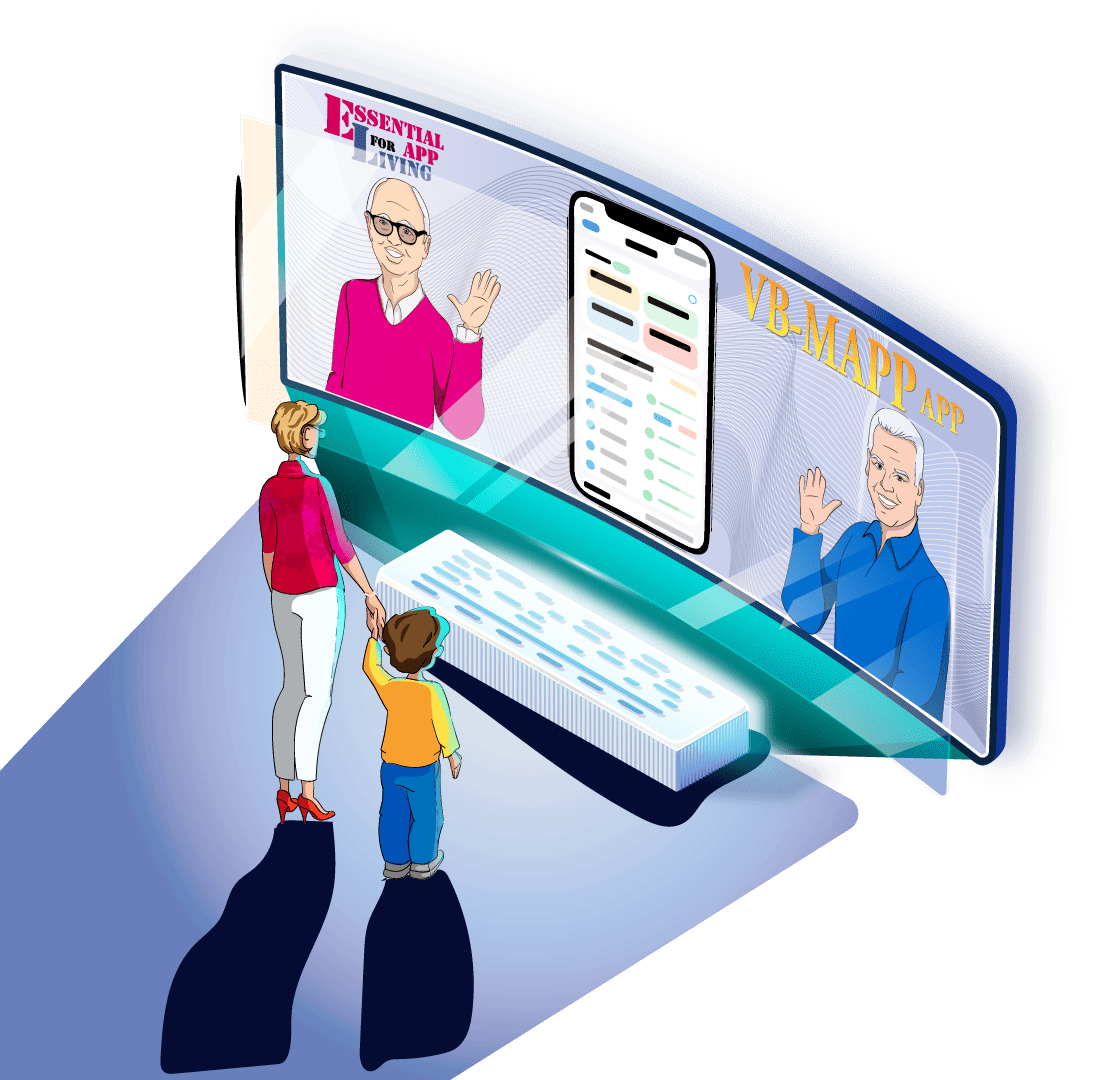
Check Out Our Apps: The VB-MAPP App and The Essential For Living App
Written by
Liz Maher
Liz Maher, MEd, BCBA, is an experienced Board Certified Behavior Analyst who provides consulting services to educational institutions and is the parent of a young adult with autism.
Want to Learn More?
Explore our resources and training programs for ABA professionals, educators, and parents.